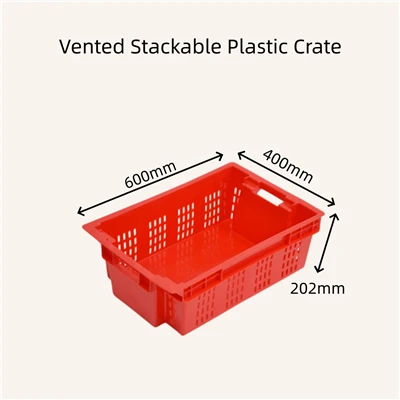
Reusable plastic crates are a long-term investment. Beyond size and material, the rib structure directly affects load capacity, durability, handling ergonomics, and logistics cost. Our 600×400mm nestable crate series offers two proven designs - vertical rib and horizontal rib - both available in the same dimensions (e.g., 600×400×315mm, 60L), PP material, stacking load, and nesting function. The only difference is how the ribs reinforce the container.
This article compares the advantages of each pattern, explains cross-stacking and nesting, and helps you choose the right one.
Shared Advantages
Both crates are built from heavy-duty, recyclable polypropylene and support a 150–200kg stacking load for safe multi-level warehouse storage. The standard 600×400mm footprint fits standard pallets and shelving systems, and an optional hinged lid provides dust protection during transit. Most importantly, both designs are fully nestable - empty crates slide inside one another to dramatically reduce shipping and storage volume.
Vertical Rib - Disadvantages
Vertical ribs distribute load efficiently downward but are less effective at containing outward pressure. When filled with agricultural produce, powders, or textiles, the side walls may bulge slightly, compromising stack alignment. The smoother vertical surface also offers less grip for manual carrying in wet or gloved conditions, and lateral impacts during conveyor or delivery handling carry a higher risk of wall stress.
Best for: Heavy dense goods such as metal parts, bottles, and cans; high-stack warehouse storage; operations requiring clean, flat label surfaces.
Horizontal Rib - Disadvantages
Horizontal ribs excel at side-impact resistance and anti-bulging, but the ridged surface makes label and barcode application difficult - adhesives may not lay flat, leading to poor scan readability. At stacking heights of five layers or more, vertical load transfer is slightly less direct than with vertical ribs. The horizontal grooves also tend to trap dust and residue, requiring more frequent cleaning in food or pharmaceutical environments.
Best for: Agricultural produce, retail distribution, e-commerce fulfillment, delivery routes, and any operation with frequent manual handling.
Nesting in a 40HQ Container: Space and Cost Savings
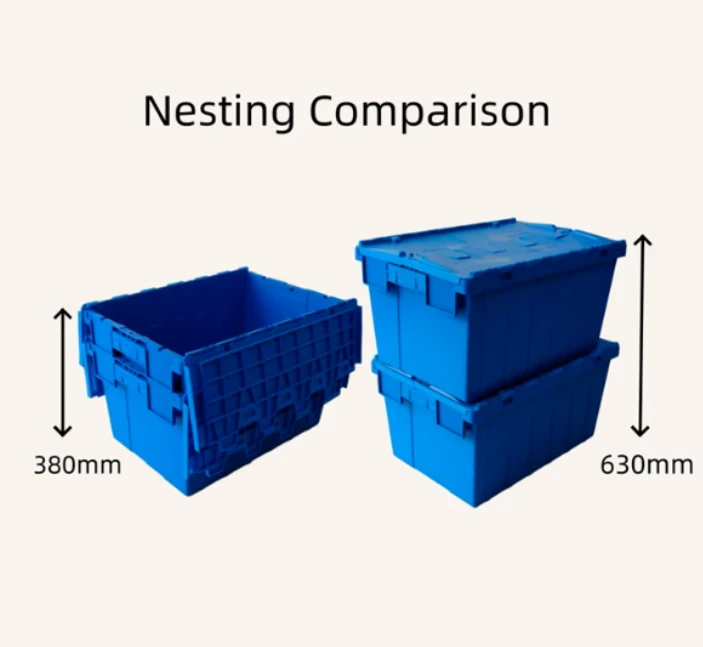
The single biggest financial benefit of these crates is nesting efficiency during empty-container transport. A standard solid-wall crate occupies its full volume whether loaded or empty; a nestable crate slides inside another, reducing the height per added unit to only the nesting increment.
For our 600×400×315mm series, two stacked empty crates measure 630mm in height, while two nested crates measure approximately 380mm - a 40% height reduction per pair. Scaled to a full 40HQ container (internal height approximately 2.69m), this means a standard stacked load of roughly 800 empty crates can be replaced by 2,000 or more nested crates in the same container. In volume terms, nesting cuts empty-container space by 60–70%.
The financial impact is significant. At a representative sea freight rate of USD 2,500 per 40HQ, shipping stacked empty crates costs roughly USD 3.10 per unit, while shipping nested crates costs approximately USD 1.25 per unit - a saving of about 60% per crate. For an importer bringing in 10,000 empty crates, this translates to roughly USD 18,500 in freight savings on a single shipment. The same logic applies to domestic trucking and warehouse storage: nested crates occupy less floor space, reduce handling trips, and lower the cost of repositioning empty containers between facilities.
Both vertical and horizontal rib models nest with equal efficiency, since nesting depends on the tapered body geometry rather than rib direction. This means your rib selection can be based entirely on cargo type and handling environment, without sacrificing logistics savings.
Cross-Stacking
Cross-stacking - rotating each layer 90 degrees - is possible on flat-base models and improves anti-toppling stability on uneven surfaces. However, it does not save space; it may slightly increase the footprint per layer and reduces the safe stacking height to three or four layers. Standard aligned stacking remains the recommended method for warehouse efficiency and maximum load capacity.
How to Choose
Choose vertical rib crates when your priority is heavy-load stacking, flat label surfaces, or dense cargo like metal parts and bottled goods. Choose horizontal rib crates when you need side-impact resistance, anti-bulging performance for produce or powders, or a more secure grip in high manual-handling environments. Both designs deliver the same nesting savings, stacking strength, and durability - the right choice depends entirely on what you ship and how you handle it.
Ready to calculate your exact savings? Contact Ningbo Simple Trading Co., Ltd. with your cargo type, monthly volume, and destination port, and we will provide a customized loading plan and quotation within 24 hours.